


Flexible, Universal, and Flanged Compensators for Pipelines
Reliable Protection for Pipeline Systems: Flexible, Universal, and Threaded Expansion Joints
Modern engineering networks require the use of high-tech solutions to ensure their durability and uninterrupted operation. LET Company offers a professional approach to equipping facilities with high-quality components, among which expansion joints, universal expansion joints, and threaded expansion joints hold a special place. These products play a critically important role in preventing pipeline destruction caused by thermal expansion, water hammer, and mechanical vibrations originating from operating equipment.
Operating pipeline systems without proper compensating elements inevitably leads to critical stresses in metal or plastic pipes. This causes joint deformation, leaks, and premature failure of expensive equipment. The use of specialized inserts allows these risks to be neutralized, ensuring the stable operation of water supply, heating, ventilation, and industrial technological lines throughout their entire design service life.
What are Expansion Joints and Their Role in Engineering Systems
An expansion joint is a special device designed to absorb linear and angular movements of pipeline sections, as well as to dampen vibrational loads. During the transportation of hot or cold media, pipes inevitably change their geometric dimensions. If such a route is rigidly fixed, thermal expansion will create colossal pressure on supports and flanged connections.
In addition to thermal deformations, engineering networks are subject to dynamic loads. Pump equipment, compressors, and turbines generate constant vibrations that are transmitted through the pipes. Compensating elements effectively isolate these oscillations, preventing the spread of noise and protecting sensitive nodes from destruction. Thus, the installation of these products is not just a recommendation, but a mandatory requirement of building codes and regulations for most modern facilities.
Main Types of Expansion Joints and Their Design Features
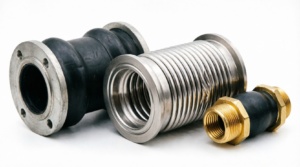
Flexible, universal, and threaded expansion joint
Depending on operating conditions, working medium parameters, and the type of expected deformations, various design configurations of compensating devices are used. LET Company ensures the supply of all main categories of this product, guaranteeing compliance with declared specifications.
Flexible Expansion Joints
Flexible expansion joints are made from elastic materials such as rubber, polymer-coated fabrics, or thin-walled metal. Their main feature is the ability to absorb complex combined movements: axial, lateral, and angular simultaneously. Rubber-fabric models are widely used in water supply and sewage systems due to their excellent damping properties and resistance to aggressive chemical environments when using special EPDM or NBR compounds.
Universal Expansion Joints
Universal expansion joints, often featuring a bellows design, are complex engineering structures capable of neutralizing deforming stresses acting in any direction. They consist of two bellows elements connected by an intermediate pipe section. This design allows for the compensation of axial, lateral, and angular movements at a single point in the pipeline, making them indispensable on complex routes with limited space for installing standard U-shaped expansion loops.
Threaded Expansion Joints
A threaded expansion joint is designed for the threaded connection of small and medium-diameter pipeline sections. This is a compact and economical solution, ideal for connecting domestic and commercial equipment such as pumps, mixers, water heaters, and boilers. The threaded design ensures quick installation without the need for welding or flange adapters, significantly reducing labor costs during commissioning.
Technical Specifications and Manufacturing Materials
The durability of compensating elements directly depends on the quality of the materials used in their production. Synthetic rubbers resistant to water, oils, acids, and alkalis are used to manufacture elastic inserts. EPDM compounds have high resistance to ozone and UV radiation, making them ideal for outdoor applications. NBR is chosen for systems where contact with petroleum products is possible.
Metallic bellows are made from corrosion-resistant steel grades AISI 304 and AISI 316L, which guarantees operation under high temperatures and pressures, and ensures maximum resistance in conditions of high humidity and chloride content. For aggressive chemical environments, PTFE (Teflon) inserts are used, which can withstand the effects of concentrated acids.
For a clear comparison of the capabilities of different product types, the following table is provided.
| Expansion Joint Type | Main Material | Compensated Movements | Working Pressure | Application Features |
|---|---|---|---|---|
| Flexible expansion joints | Rubber, fabric, metal | Axial, angular, lateral | Up to 16 bar | Water supply, ventilation, pump stations |
| Universal expansion joints | Stainless steel | Axial, lateral, angular simultaneously | Up to 40 bar | Complex pipeline routes, heating networks |
| Threaded expansion joints | Rubber, brass, steel | Axial, vibrational | Up to 16 bar | Residential and commercial sectors, pump connections |
Areas of Application for Expansion Joint Equipment
The scope of use of these products covers almost all sectors of industry and civil construction. In housing and communal services, they are installed in internal heating and water supply systems of apartment buildings to protect risers from destruction during seasonal temperature fluctuations.
In the industrial sector, flexible and universal models are critically important at chemical and oil refining plants where aggressive and high-temperature media are transported. In ventilation and air conditioning systems, fabric inserts are used to isolate vibrations from industrial fans and prevent the transmission of structural noise through air ducts.
Advantages of Using Expansion Joints in Pipeline Systems
Integrating compensating elements into the design of pipeline valves and pipelines provides numerous operational and economic benefits for the facility owner.
- Prevention of emergency situations by relieving mechanical stress from pipes and fittings.
- Significant reduction in noise and vibration levels, increasing comfort in residential and office buildings.
- Protection of expensive pump and compressor equipment from destructive water hammer.
- Compensation for installation errors and uneven foundation settlement of the building.
- Increased overall service life of the engineering network and reduced capital repair costs.
How to Choose the Right Expansion Joint for Your Facility
Selecting the optimal model requires considering multiple technical parameters. A miscalculation can lead to premature wear of the product or its destruction under load.
- Determination of the working medium type: water, steam, gas, chemical reagents, or bulk materials.
- Consideration of maximum and minimum working pressure in the system, including possible water hammer.
- Analysis of the operating temperature range, as different materials have their own heat resistance limits.
- Calculation of expected pipeline movement amplitudes based on route length and temperature drops.
- Selection of connection type: flanged, threaded, or welded, depending on the existing infrastructure.
Estimated Cost of Expansion Joints in Moscow
The pricing of compensating equipment depends on the nominal diameter, working pressure, material of manufacture, and the volume of the ordered batch. The holding company “Laboratory of Electrochemical Technologies” (LET) offers competitive conditions for partners, ensuring direct supplies from verified manufacturers without intermediary markups.
| Product Name | Diameter (DN) | Working Pressure (PN) | Estimated Price | Delivery Time |
|---|---|---|---|---|
| Threaded rubber expansion joint | 25-50 mm | 16 bar | from 1,500 RUB | In stock |
| Flanged flexible expansion joints | 50-150 mm | 10-16 bar | from 3,500 RUB | 2-5 days |
| Universal bellows expansion joints | 100-300 mm | 16-25 bar | from 12,000 RUB | 5-10 days |
| Fabric flexible inserts | 200-500 mm | Low pressure | from 8,000 RUB | Made to order 7-14 days |
*The specified prices are indicative and may be adjusted depending on the individual requirements of the project, order urgency, and the current logistics situation. To obtain an accurate commercial offer, it is recommended to contact the company’s technical specialists.
Installation and Operation: Key Recommendations
Even the highest quality equipment requires compliance with installation rules to realize its built-in potential. During installation, the flow direction indicated on the product body must be strictly observed. It is forbidden to use expansion joints as elements for aligning pipe axes in cases of serious installation misalignments.
When installing flanged models, fastening bolts should be tightened evenly in a cross pattern to avoid distortion of the sealing surfaces. For universal bellows models, the installation of guiding supports is often required to prevent lateral bending and twisting of the bellows under pressure. It is also necessary to install travel limiters for axial expansion joints to prevent stretching beyond calculated values during system strength testing. Regular visual inspection during operation allows for the timely identification of signs of material fatigue or corrosion and the replacement of the element before an emergency situation occurs.
Why Order Expansion Joints from LET Company
The company has established itself as a reliable supplier of engineering equipment, offering comprehensive solutions for equipping facilities of any complexity. We do not just sell products; we provide expert support at all stages: from selecting the optimal model to consulting on installation issues.
All supplied products are accompanied by the necessary technical documentation, passports, and certificates of compliance with state standard requirements. A flexible logistics policy allows for the prompt delivery of orders across Moscow and any region of Russia, minimizing downtime at construction sites.
To get detailed consultation, check warehouse availability, or place an order, please contact us in a way that is convenient for you:
- Phone: ☎ +7 (495) 232-00-66
- Email: let@eca.ru
Entrust the protection of your engineering networks to professionals. Timely installation of high-quality compensating elements guarantees stable communication operation, personnel safety, and significant savings on repairs in the long term.