


Photoionization Gas Analyzer
Photoionization Gas Analyzer: Complete Guide to Selection and Application
In modern conditions of industrial safety and environmental control, requirements for accuracy and speed of hazardous substance detection are steadily increasing. Among the wide variety of gas analysis tools, the photoionization gas analyzer occupies a special place. This class of instruments provides highly sensitive and rapid detection of volatile organic compounds (VOCs) and other toxic components in workplace air, atmospheric air, and confined spaces. The LET Company offers professional solutions in this area, combining advanced technologies with reliable service support.
What is a Photoionization Gas Analyzer and its Operating Principle
A Photoionization Detector (PID) is a high-tech instrument designed to analyze the surrounding atmosphere and determine levels of various chemical substances. Unlike traditional semiconductor or catalytic sensors, the photoionization method is based on the use of ultraviolet radiation.
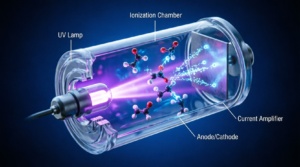 The operating principle is based on the following physical process: the analyzed gas mixture is irradiated with ultraviolet light from a special lamp. If the photon energy of UV radiation exceeds the ionization energy of the molecules of the substance present, an electron is detached and positively charged ions are formed. A gas analyzer using the photoionization method measures the total concentration of substances with ionization energy less than 11.8 eV (standard value for most industrial UV lamps).
The resulting ions are attracted to the collector, creating an electric current whose strength is directly proportional to the concentration of ionized molecules in the sample. The electronic circuit of the instrument amplifies this microscopic current, converts it into a digital value, and displays it on the screen as a concentration (in ppm, ppb, or mg/m³). After measurement, the ions recombine back into neutral molecules, which allows the instrument to take measurements continuously without irreversible changes to the sample composition.
What Substances Does the Photoionization Method Detect?
The key feature of photoionization analyzers is their ability to detect a wide spectrum of volatile organic compounds (VOCs), which often remain invisible to standard combustible gas or oxygen sensors. These include:
- Aromatic hydrocarbons (benzene, toluene, xylene, styrene).
- Ketones and aldehydes (acetone, formaldehyde).
- Chlorinated hydrocarbons and solvents.
- Sulfur compounds and amines.
- Vapors of gasoline, diesel fuel, and various industrial solvents.
An important advantage is the high resistance of the sensor to poisoning by high-concentration gases, which often disables catalytic or electrochemical cells. This makes photoionization instruments an ideal choice for working in aggressive chemical environments.
For clarity, the table below shows examples of substances that are effectively detected by the photoionization method and their ionization energies:
| Substance | Chemical Formula | Ionization Energy, eV | Detected by 10.6 eV UV Lamp |
|---|---|---|---|
| Benzene | C₆H₆ | 9.24 | Yes |
| Toluene | C₇H₈ | 8.82 | Yes |
| Acetone | C₃H₆O | 9.69 | Yes |
| Formaldehyde | CH₂O | 10.88 | Requires 11.8 eV lamp |
| Ethanol | C₂H₅OH | 10.48 | Yes |
| Styrene | C₈H₈ | 8.39 | Yes |
Classification of Photoionization Gas Analyzers
Depending on the tasks and operating conditions, the equipment is divided into two main categories:
Portable (Handheld) Gas Analyzers
These are compact wearable devices designed for individual personnel protection, one-time measurements, or site surveys. A portable photoionization gas analyzer is often equipped with a built-in membrane pump for forced sample extraction, which allows measurements in hard-to-reach places: wells, tanks, tunnels, and ventilation shafts. Modern models feature explosion-proof design (1Ex marking), which is critical for working at oil depots, gas stations, and chemical plants.
Stationary Gas Analyzer Sensors
A stationary photoionization gas analyzer is designed for continuous 24/7 monitoring of permissible exposure limits (PEL) of harmful substances in the air of industrial premises. Such devices typically have a durable housing made of stainless steel or aluminum, protected against dust and moisture to IP65 standard and above. They are integrated into general industrial safety systems, transmitting analog signals (4-20 mA) or digital data (RS-485, Modbus) to the control panel for automatic activation of emergency ventilation or blocking of technological processes.
For ease of selection between portable and stationary models, a comparison table of their key characteristics is provided below:
| Parameter | Portable Gas Analyzer | Stationary Gas Analyzer |
|---|---|---|
| Purpose | Individual protection, one-time measurements, site surveys | Continuous 24/7 monitoring of premises |
| Mobility | High, worn on belt or handheld | Fixed installation at a specific point |
| Sample Collection | Diffusion or forced (with pump) | Diffusion (natural convection) |
| Housing | Plastic, impact-resistant, compact | Metal (stainless steel, aluminum), IP65+ |
| System Integration | Autonomous operation, local alarm | Connection to control systems, SCADA, dispatch panels |
| Power Supply | Rechargeable battery (8-12 hours of operation) | 220V mains or 24V DC |
| Typical Application Areas | Wells, tanks, laboratories, field conditions | Production workshops, fuel storage facilities, boiler rooms |
Areas of Application
The versatility and high sensitivity determine the wide scope of use of photoionization gas analyzers:
- Oil and gas and chemical industry: leak detection on pipelines, tank farms, compressor stations, and in laboratories.
- Environmental monitoring: assessment of atmospheric air pollution in sanitary protection zones of enterprises, soil and groundwater quality control at former industrial landfill sites.
- Emergency services (EMERCOM): rapid assessment of chemical situations during hazardous substance spills, fires at chemical facilities, or railway accidents.
- Confined space work: mandatory atmosphere control before personnel descent into collectors, sewer networks, silos, and ship holds where toxic vapors may accumulate.
- Pharmaceuticals and paint and varnish production: monitoring solvent vapor content in workplace air to ensure compliance with occupational safety standards.
Key Advantages of the Photoionization Method
- Extremely high sensitivity: ability to detect concentrations at parts per billion (ppb) levels, which is unattainable for most other types of sensors.
- Instant response: response time (T90) is usually less than 3-5 seconds, which allows rapid detection of leak sources and taking action.
- Wide detection spectrum: one instrument replaces several specialized sensors as it responds to hundreds of different organic compounds.
- No false alarms from water vapor: unlike some infrared or semiconductor sensors, photoionization detectors operate correctly in high humidity conditions.
- Sensor durability: absence of catalytic combustion processes or irreversible chemical reactions inside the cell extends the detector’s service life.
How to Choose a Photoionization Gas Analyzer: Checklist
When selecting equipment for professional use, it is necessary to consider a number of critical parameters:
- Registration in the State Register of Measuring Instruments of the Russian Federation: the instrument must be included in the State Register of Measuring Instruments, which legalizes its use at Rostekhnadzor-controlled facilities and allows the use of obtained data in official reporting.
- Explosion protection: for work in fire-hazardous areas, explosion protection marking (e.g., 1ExibdIIBT4 X) confirming the device’s safety is mandatory.
- Lamp ionization energy: standard 10.6 eV lamps cover most tasks. For specific compounds (e.g., some freons or formaldehyde), 9.8 eV or 11.8 eV lamps may be required.
- Measurement range: it is necessary to match expected concentrations with the instrument’s range. Some models offer automatic scale switching to maintain accuracy at both low and high concentrations.
- Built-in pump availability: for sampling from wells or containers, a powerful suction pump (capable of overcoming the resistance of long probes) is mandatory.
- Calibration interval: the calibration interval (usually 1-2 years) and availability of calibration techniques at accredited metrological centers should be clarified.
Maintenance and Metrological Support
The accuracy of any measuring instrument can drift over time due to contamination of the UV lamp optics or aging of electronic components. Therefore, a photoionization gas analyzer requires regular maintenance. Each device upon delivery must be accompanied by a passport and a primary factory calibration certificate.
To maintain declared accuracy, periodic calibration using certified calibration gas mixtures (most often based on isobutylene or benzene) is recommended. The LET Company provides a full cycle of support: from helping with alarm threshold settings to organizing subsequent periodic calibration and replacement of consumables (UV lamps, filters).
Why Order a Photoionization Gas Analyzer from the LET Company
The LET Company is a reliable and official supplier of modern equipment for gas environment analysis. We understand that when working with toxic and explosive environments, the price of a mistake is too high, so we offer only certified instruments that meet strict Russian and international standards.
Our advantages:
- Wide assortment: the catalog presents both portable models for individual protection and complex stationary continuous monitoring systems.
- Quality assurance: all offered gas analyzers are included in the State Register of Measuring Instruments of the Russian Federation and have the necessary explosion protection certificates.
- Professional support: company engineers will provide free consultation, help select a model for specific technological tasks, and calculate cost and delivery time.
- Convenient logistics: we ensure fast and reliable delivery of ordered equipment to any point in the Russian Federation.
- After-sales service: we provide technical maintenance, calibration, and personnel training on instrument operation rules.
Approximate Prices in Moscow
The cost of photoionization gas analyzers depends on the number of measured components, presence of a built-in pump, explosion-proof design, and configuration. Approximate prices for popular equipment models relevant to the Moscow market are provided below:
| Equipment Type | Example Model | Approximate Price in Moscow, ₽ |
|---|---|---|
| Portable single-detector | KOLION-1V | From 85,000 to 110,000 |
| Portable multi-component | KOLION-1V-24 | From 135,000 to 160,000 |
| Stationary gas analyzer sensor | DAF-M | From 90,000 to 140,000 |
| Stationary monitoring system | FGDA (complex with controller) | From 150,000 to 250,000 |
*The specified prices are approximate and may vary depending on the exchange rate, configuration (availability of primary calibration, spare parts and tools kit, carrying case), and delivery terms.
Factors affecting the final cost:
- Need for delivery to regions of the Russian Federation.
- Ordering additional replaceable UV lamps or filters.
- Required calibration interval and availability of calibration certificate at the time of shipment.
- Individual requirements for alarm threshold settings.
To obtain an accurate commercial proposal and current price list, it is recommended to contact the managers of the LET Company.
A photoionization gas analyzer is an indispensable tool for any specialist responsible for industrial safety, occupational health, or environmental control. The combination of high sensitivity, fast response, and versatility makes this detection method the gold standard when working with volatile organic compounds.
Do not risk personnel safety and the environmental reputation of your enterprise. Entrust the selection and supply of gas analytical equipment to professionals.
Contact us to receive an individual proposal:
- Email: let@eca.ru
- Phone: +7 (495) 232-00-66
Specialists of the LET Company are ready to answer all your questions, help select the optimal model, and organize prompt delivery of equipment with a complete package of authorization documentation.